I'm afraid that, at least for these first few posts, it's going to sound a lot like a summary of a chapter of Godel, Escher, Bach (GEB). Hopefully my essay isn't like that.
Hofstadter begins the book with a puzzle of his own invention, which I will reproduce here. The MU-puzzle includes three and only three letters: M, I, and U. Groups of these three letters are referred to in the system as "strings" (which include MIU, IMMUMMU, MIUIUIUIU, and such). The puzzle consists of beginning with a given string, MI, and trying to produce the string "MU" within the limits of the following rules:
1. If the string's last letter is "I", you can add a "U" to the end.
2. You can produce a new string by duplicating everything after the "M". For example, MI can become MII, MUIUI can become MUIUIUIUI, MUU can become MUUUU, etc.
3. You can replace "III" with a "U" at any point in the string if you wish.
4. If you have a "UU" anywhere in the string, you can delete it (the "UU", not the string).
If you're a total nerd like I am, you might actually find some enjoyment in trying to produce the string "MU". I didn't, but Hofstadter explains in GEB that he doesn't mean for the puzzle to be solved (although he says the solution is later in the book). Solving the puzzle itself gives you experience with some of the workings of formal systems.
Hofstadter refers to given strings like "MI" as axioms, statements that you must assume to begin with since they cannot be proven. Strings produced from the axiom are called theorems, since they are provable on the basis of the axiom and the given rules.
The reason that formal systems are such a frequently-used tool of GEB is because humans and computers treat them so differently. I played with the MU-puzzle for maybe five to ten minutes before giving up. I don't know if there really is an answer, or if the author will present some "cheater" solution later in the book. But if it is truly impossible to produce "MU", a computer would continue attempting the theorem indefinitely, whereas a human would, eventually, give up.
In Hofstadter's words, jumping out of the system is a skill that seems almost wholly unique to humans. Humans "jump out of the system" by giving up on a task, postponing a task, trying to change the rules, etc. And jumping out of the system isn't always bad; in fact, exiting a system is many times an intelligent move. Computers inherently have a problem with exiting systems because staying in the system is usually what they are programmed to do.
Hofstadter then uses the three letters of the MIU-system to describe three different ways to approach a task or a system:
-Mechanical mode (M-mode), in which the task is carried out systematically much like a computer would do,
-Intelligent mode (I-mode), in which the subject learns how to use the rules and creates new ways of solving the task, much like a human would do, and
-Un-mode (U-mode), which Hofstadter doesn't describe at this point, but I assume involves jumping out of the system or changing the rules, thereby altering the internal system you began with.
Bored yet?
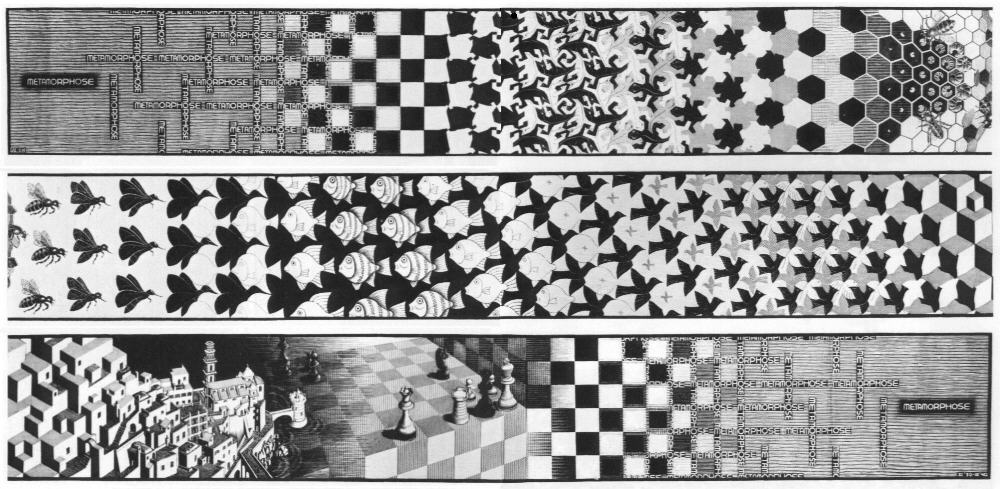
Metamorphose
Tuesday, December 31, 2013

Saturday, December 28, 2013
Godel, Escher, Bach
Well, I'm back. I decided to resurrect this blog because of something I'm starting to work on in college. I'm involved in the honors program at my school, and part of the program is completing what's called a great questions essay. I'm mainly using this blog right now to have a place to gather and organize my thoughts. I want to have a better idea of exactly how I want to approach this, and writing about it helps. I don't think much of this will appeal to a wide range of people, and I don't know how much I expect it to be read. Frankly, I think a lot of people will find it boring. However, it would be helpful for me to have this as a sounding board where others could give me ideas or opinions I can use, but I guess we'll see how well that pans out.
The essay I'm going to write will be based largely on a few themes from the book "Godel, Escher, Bach" by Douglas Hofstader. I was introduced to this work while reading a spinoff of Harry Potter called "Harry Potter and the Methods of Rationality". And yes, it is at least as geeky as the title implies. I like it because I'm a science nerd and so is the pseudo-Harry in the story. Anyway, the story references "Godel, Escher, Bach" (hereafter referred to as GEB) several times. Some time after starting to read this, I was looking at some things I could do to complete other requirements of the honors program, and reading GEB was one of them. I thought I would give it a try.
It's a tough book. It's tough no matter who you are. One distinguishing feature of GEB is just how familiar the author is with many academic disciplines. His main background, as evident from the book, is mathematics, computer science, physics, and philosophy; but he is also quite adeptly acquainted with life sciences, music, literature, art, and even Zen. I especially enjoy how much effort Hofstadter puts in to "dumbing down" the subject at first just enough for me to understand it. It makes it an interesting read for me because it's a challenge, as if the author is daring me to intellectually keep up and try to understand what he's explaining. What impressed me the most is how smoothly he incorporates all these areas of study to describe one of the overarching themes of the book: consciousness. He often explores this through the question: "Can a machine be programmed to think, act, or operate the way humans do?"
This is the great question I plan to address in my essay. Because GEB covers this topic so thoroughly, most of my posts here are going to be a sort of commentary about principles Hofstadter discusses in the book. However, I may later depart from those more often, since I plan in my essay to address the theological perspective of the issue, which Hofstadter never touches. To those reading this post, I would recommend trying to read a couple posts if you're interested, and if you're still bored after that, give up. I don't want to waste anyone's time with this blog if what I discuss isn't what you're interested in. But if it does appeal to you, it would be helpful to have additional feedback. So here goes.
The essay I'm going to write will be based largely on a few themes from the book "Godel, Escher, Bach" by Douglas Hofstader. I was introduced to this work while reading a spinoff of Harry Potter called "Harry Potter and the Methods of Rationality". And yes, it is at least as geeky as the title implies. I like it because I'm a science nerd and so is the pseudo-Harry in the story. Anyway, the story references "Godel, Escher, Bach" (hereafter referred to as GEB) several times. Some time after starting to read this, I was looking at some things I could do to complete other requirements of the honors program, and reading GEB was one of them. I thought I would give it a try.
It's a tough book. It's tough no matter who you are. One distinguishing feature of GEB is just how familiar the author is with many academic disciplines. His main background, as evident from the book, is mathematics, computer science, physics, and philosophy; but he is also quite adeptly acquainted with life sciences, music, literature, art, and even Zen. I especially enjoy how much effort Hofstadter puts in to "dumbing down" the subject at first just enough for me to understand it. It makes it an interesting read for me because it's a challenge, as if the author is daring me to intellectually keep up and try to understand what he's explaining. What impressed me the most is how smoothly he incorporates all these areas of study to describe one of the overarching themes of the book: consciousness. He often explores this through the question: "Can a machine be programmed to think, act, or operate the way humans do?"
This is the great question I plan to address in my essay. Because GEB covers this topic so thoroughly, most of my posts here are going to be a sort of commentary about principles Hofstadter discusses in the book. However, I may later depart from those more often, since I plan in my essay to address the theological perspective of the issue, which Hofstadter never touches. To those reading this post, I would recommend trying to read a couple posts if you're interested, and if you're still bored after that, give up. I don't want to waste anyone's time with this blog if what I discuss isn't what you're interested in. But if it does appeal to you, it would be helpful to have additional feedback. So here goes.
Tuesday, July 13, 2010
Goodbye
Today (when I wrote this) is my nineteenth birthday. Or, was. I had a spectacular day, filled with spending time with friends, making and eating my birthday Jell-o cake (chocolate cake with cherry-flavored Jell-o, the best kind), finishing the last of my "Movies to watch before I leave" list, and watching my favorite movie, the Lion King (Yep, it's not just my favorite Disney movie anymore. I finally caved in and decided it should hold that place. It deserves it. Mostly because of how special it became for me in college...and the epic music by Hans Zimmer. The music wins EVERYTHING.), as a sort of final hurrah to the life I used to lead. And I don't regret it. I'm going on to what I truly hope and believe will be one of the best and most fulfilling times of my life. Which, for those who don't know--if there are any--will be serving as a full-time missionary for the Church of Jesus Christ of Latter-Day Saints, commonly known as the LDS or Mormon church, in the Alabama Birmingham mission speaking English for a period of 24 months beginning Wednesday, July 14th. Tomorrow. Aagh. And, for those who don't know what I'm about to tell you (which is probably a significantly larger number than before), here is why.
First, I feel that I should serve a mission. The leaders of my church have strongly encouraged all young men of my age and worthiness to do so, and I am no exception. But that alone would not be reason enough to embark on a two-year journey such as this. I feel duty bound to do this because I know that my Lord and Savior Jesus Christ came to this earth to suffer for our sins and die for us so that we could be saved from sin ourselves. I know that He was resurrected so that we, too, could partake of the boundless glory that comes with the reuniting of body and spirit after death. I know that He gave everything He had and everything He was in the garden of Gethsemane to truly take upon Himself the pains and sorrows of all men. The fact that my Brother gave more than I could ever comprehend compels me to serve Him in an attempt to repay what He has done for me and for everyone. I know that He led a church when he was physically on the earth. I know that church and the fullness of the gospel left the earth for a period of time we call the Apostasy, due to the loss of authority and true doctrine carried on by his apostles that, because it was not passed on to another, was withdrawn for a time with their deaths. I know that, after this apostasy, the gospel in its entirety was restored through the prophet Joseph Smith. I know that this is His same church that existed on the earth when He walked among men, for it bears his name: The Church of Jesus Christ of Latter-Day Saints. That is one way I am trying to repay him: by serving a full-time mission for His church in an effort to bring souls to Him.
Second, I want to. The knowledge of God's love and devotion to His children gives me a desire to develop that same love for them and for His gospel, and I know that a mission is a great way to do that. I know that a mission is a great way to develop skills, traits, and general growth that will be immensely beneficial in all aspects of my life. I know that it will make me a better person if I let it. But most of all, I want to do this because I love Him. I love His teachings and His gospel. I love that he restored the fullness of the gospel and brought forth the Book of Mormon (which I also love) to testify of his Son, Jesus Christ (whom I also love), in our day and to tell of the wonderful blessings we can receive if we are repentant and keep the commandments. I love that I was born and raised in the gospel in a country where I am free to live it to the fullest extent. I love all that the Lord has taught me and I continually hunger and thirst for more of His glorious gospel. And when you love something that much, you can't just keep it to yourself. You have to tell it to the world (or, in my case, Birmingham, Alabama).
Finally, I need to. I know it's not technically commanded of us specifically to serve a full-time mission, but according to D&C 88:81-82, we are commanded to share the gospel with others if we have received it for ourselves. I just think that this is the best way for me to fulfill this commandment at this time. Sure, I've sacrificed a lot of money paying for my clothes and luggage and other necessities, and I'm sure I will sacrifice my time, sanity, and more when I'm in Alabama. But I know I'll receive great blessings for it. And, if nothing else, it's nothing compared to what Jesus Christ sacrificed for us. Everything I give will just be a drop in the pond compared to the flood of mercy He has covered us with. And sacrifice isn't really losing something, anyway. It's giving up something good for something better. And I have full confidence that, even though I'm saying goodbye for two years to something good, at 12:45 on Wednesday, July 14th, I'll be starting into something better.
And I'm not looking back.
Actually, that's not entirely true. That was just my cheesy, storybook ending to all this. I'll still keep in touch and write letters and stuff.
But, you know.
First, I feel that I should serve a mission. The leaders of my church have strongly encouraged all young men of my age and worthiness to do so, and I am no exception. But that alone would not be reason enough to embark on a two-year journey such as this. I feel duty bound to do this because I know that my Lord and Savior Jesus Christ came to this earth to suffer for our sins and die for us so that we could be saved from sin ourselves. I know that He was resurrected so that we, too, could partake of the boundless glory that comes with the reuniting of body and spirit after death. I know that He gave everything He had and everything He was in the garden of Gethsemane to truly take upon Himself the pains and sorrows of all men. The fact that my Brother gave more than I could ever comprehend compels me to serve Him in an attempt to repay what He has done for me and for everyone. I know that He led a church when he was physically on the earth. I know that church and the fullness of the gospel left the earth for a period of time we call the Apostasy, due to the loss of authority and true doctrine carried on by his apostles that, because it was not passed on to another, was withdrawn for a time with their deaths. I know that, after this apostasy, the gospel in its entirety was restored through the prophet Joseph Smith. I know that this is His same church that existed on the earth when He walked among men, for it bears his name: The Church of Jesus Christ of Latter-Day Saints. That is one way I am trying to repay him: by serving a full-time mission for His church in an effort to bring souls to Him.
Second, I want to. The knowledge of God's love and devotion to His children gives me a desire to develop that same love for them and for His gospel, and I know that a mission is a great way to do that. I know that a mission is a great way to develop skills, traits, and general growth that will be immensely beneficial in all aspects of my life. I know that it will make me a better person if I let it. But most of all, I want to do this because I love Him. I love His teachings and His gospel. I love that he restored the fullness of the gospel and brought forth the Book of Mormon (which I also love) to testify of his Son, Jesus Christ (whom I also love), in our day and to tell of the wonderful blessings we can receive if we are repentant and keep the commandments. I love that I was born and raised in the gospel in a country where I am free to live it to the fullest extent. I love all that the Lord has taught me and I continually hunger and thirst for more of His glorious gospel. And when you love something that much, you can't just keep it to yourself. You have to tell it to the world (or, in my case, Birmingham, Alabama).
Finally, I need to. I know it's not technically commanded of us specifically to serve a full-time mission, but according to D&C 88:81-82, we are commanded to share the gospel with others if we have received it for ourselves. I just think that this is the best way for me to fulfill this commandment at this time. Sure, I've sacrificed a lot of money paying for my clothes and luggage and other necessities, and I'm sure I will sacrifice my time, sanity, and more when I'm in Alabama. But I know I'll receive great blessings for it. And, if nothing else, it's nothing compared to what Jesus Christ sacrificed for us. Everything I give will just be a drop in the pond compared to the flood of mercy He has covered us with. And sacrifice isn't really losing something, anyway. It's giving up something good for something better. And I have full confidence that, even though I'm saying goodbye for two years to something good, at 12:45 on Wednesday, July 14th, I'll be starting into something better.
And I'm not looking back.
Actually, that's not entirely true. That was just my cheesy, storybook ending to all this. I'll still keep in touch and write letters and stuff.
But, you know.
Fasting with a purpose
I want to write about an experience I had which strengthened my testimony of fasting. One Sunday a few weeks ago, I fasted to have a greater sensitivity to missionary opportunities and the courage to take advantage of them. The next day, I definitely noticed the difference. I was at work with my coworkers Janet (who is a member of the church) and Rick (who isn't). Yes, I changed the names. Out of the blue, Rick randomly started talking about how he thought it was unfair that Mormon missionaries should have to pay for their own missions. He said a few other things, and in the course of this discussion he found out that I was soon leaving for a mission (and I found out that he didn't know that previously). He didn't apologize for what he said, but he stopped talking badly about the prospect of a mission. I found out that he had been LDS and had entertained the possibility of going on a mission (however briefly) long ago. He still goes to church (whether LDS or not, I'm not sure). I also overheard Rebecca mention to Sam that she knew he wasn't LDS, which I didn't know before, either.
On the way home from work, I evaluated my relationship with every one of my coworkers, their relationship with religion/the gospel, and possible ways I could share the gospel with them. While doing this, I realized just how blessed I was to have my eyes opened to their situations. Rick's random mentioning of a mission was completely unexpected, and I doubt that it would have happened if I didn't fast for it. I saw a difference in myself of a heightened spiritual awareness of who these people were and how I could help them.
I decided that it's not enough just for everyone to know that I am a Mormon. I want to be more than just a good example or the guy that his coworkers don't swear around. I'm going to be a full-time missionary in a little over a month (at the time I wrote this), and it's time I start acting like it. God doesn't want me to be just a good example, a good worker, or a good all-around person. Being good people isn't what sets us apart from the rest of the world. Being hard workers isn't what makes us the unique, "peculiar people" described in the Bible. There are many Mormons who are not good people or hard workers, and vice versa. What really makes us different is our love for Jesus Christ, His Atonement, God's plan of happiness, and (most importantly) the gospel restored by Joseph Smith to this earth with all its teachings, ordinances, and priesthoods. There's a popular saying in the church that goes something like this: "You may be the only scriptures some people ever read, the only church some people go to, the only connection some people have with God". Well, that's all fine and good, but why not take it a step further? Why not show them the real scriptures, the real church, the real God clear as crystal instead of through the clouded and imperfect lens of your own human nature? As Brother Christiansen would say in his mission prep class, "You're just a stupid 19-year-old. Why should anyone believe you?"
Real missionary work isn't just being the kind of person that nonmembers or inactive members want to be like, because that does almost nothing in the way of conversion (although sometimes that's all you can do). Even if we have role models that we view as respectable, honorable people, they are still imperfect and can fail us. Almost anything or anyone can fail us, except for three holy Beings. We call them the Father, the Son, and the Holy Ghost. Those are the things that change us. And unless you access the testimony-bearing powers of the Holy Ghost through scripture, service, love, testimony, or any other method, you won't change anything or anyone. And if being a good example is all you can do, let it be in the name of Christ, not to satisfy your own pride or desires. But if you have the opportunity to take your missionary work a step higher, DO IT. The more direct connection they can have with God, the better. The less there is of you, the better. You are only an instrument to lead people to God, because without Him, you are nothing. Worthless. Dead. But if we align our will with His and work with Him to bring others into the church, that is when missionary work truly happens. That is true conversion.
People don't change hearts. God changes hearts.
So can't we just get out of the way and let Him in?
On the way home from work, I evaluated my relationship with every one of my coworkers, their relationship with religion/the gospel, and possible ways I could share the gospel with them. While doing this, I realized just how blessed I was to have my eyes opened to their situations. Rick's random mentioning of a mission was completely unexpected, and I doubt that it would have happened if I didn't fast for it. I saw a difference in myself of a heightened spiritual awareness of who these people were and how I could help them.
I decided that it's not enough just for everyone to know that I am a Mormon. I want to be more than just a good example or the guy that his coworkers don't swear around. I'm going to be a full-time missionary in a little over a month (at the time I wrote this), and it's time I start acting like it. God doesn't want me to be just a good example, a good worker, or a good all-around person. Being good people isn't what sets us apart from the rest of the world. Being hard workers isn't what makes us the unique, "peculiar people" described in the Bible. There are many Mormons who are not good people or hard workers, and vice versa. What really makes us different is our love for Jesus Christ, His Atonement, God's plan of happiness, and (most importantly) the gospel restored by Joseph Smith to this earth with all its teachings, ordinances, and priesthoods. There's a popular saying in the church that goes something like this: "You may be the only scriptures some people ever read, the only church some people go to, the only connection some people have with God". Well, that's all fine and good, but why not take it a step further? Why not show them the real scriptures, the real church, the real God clear as crystal instead of through the clouded and imperfect lens of your own human nature? As Brother Christiansen would say in his mission prep class, "You're just a stupid 19-year-old. Why should anyone believe you?"
Real missionary work isn't just being the kind of person that nonmembers or inactive members want to be like, because that does almost nothing in the way of conversion (although sometimes that's all you can do). Even if we have role models that we view as respectable, honorable people, they are still imperfect and can fail us. Almost anything or anyone can fail us, except for three holy Beings. We call them the Father, the Son, and the Holy Ghost. Those are the things that change us. And unless you access the testimony-bearing powers of the Holy Ghost through scripture, service, love, testimony, or any other method, you won't change anything or anyone. And if being a good example is all you can do, let it be in the name of Christ, not to satisfy your own pride or desires. But if you have the opportunity to take your missionary work a step higher, DO IT. The more direct connection they can have with God, the better. The less there is of you, the better. You are only an instrument to lead people to God, because without Him, you are nothing. Worthless. Dead. But if we align our will with His and work with Him to bring others into the church, that is when missionary work truly happens. That is true conversion.
People don't change hearts. God changes hearts.
So can't we just get out of the way and let Him in?
Monday, May 3, 2010
Music is memory, emotion, life (or: Music according to Dallin Dressman)
This post is very, very long. Probably the longest one I've ever written. Take your time. Basically this is a brief (compared to what I could write) description about what music means to me and my opinions about it.
I'll start back when I was 12. I was taking drum lessons from a high schooler who lived nearby, and one day we sat down by his computer in hopes of helping him discern what kind of music I liked. Every genre he tried to show me came up with a response like, "I don't know...it's kind of cool, I guess." The best description he could get out of me pertaining to the kind of music I liked was that I enjoyed music that made me feel good while riding in the car and looking out the window. The concept that I didn't know what kind of music I liked was totally alien to him, as it is to me now.
Music didn't really start to become a part of me until high school. The main thing that started me developing attitudes and opinions about music was my job at Little Caesar's during my senior year. I absolutely loved that job and all the people I worked with, but my one complaint (minor, really) was the music they listened to. About 90% of it was rap and/or pop, and what's worse, it was on stations that overplayed the music to a bloody pulp (I swear they just cycled the same 10 songs all day). I developed an extensive bias against these genres and the radio in general (specifically Movin' 100.7 and 97.1 ZHT). I came to view this music as unintelligent, crude, talent-starved, and worthless. Granted, much of it was, but the attitude I formed was that it was the nature of the genre that was responsible for these flaws, not the individual artists (although I hated them too). I couldn't seem to entertain the possibility that rap could ever be "quality music", or even music at all. Gimmicks like Autotune (which I still do and always will dislike) only made it worse.
During this period of being engulfed in music that I found distasteful, my natural instinct was to desperately search for what I thought was "quality music", and I did. Over time, I formed strong opinions about what was and what was not well-produced music, and that was ultimately when music started to become a part of me. I came to enjoy certain songs or bands so much that I felt personally insulted when I found that another person disliked them. I considered my music an extension of my personality, and if somebody messed with my music, they messed with me (which led to a lot of really awkward arguments). I considered myself to be exceptionally gifted in the art of analyzing music, and while this may have been a bias in itself, it wasn't the real problem. I used this so-called talent to justify my attitude that what I liked must have been good music, and what I didn't like must have been poor or low-quality music. I didn't care how many people liked Taylor Swift's "Love Story"; I hated it, so it was clearly not good music. I even started asserting that people who like music I disliked didn't know what they were talking about and simply had no idea what good music really was. I had a hard time stopping myself from instantly judging people based on what kind of music they like. It was getting out of control.
Luckily, I got some help. One night, as I was particularly fed up with rap and pop, I posted a conceited note on Facebook outlining my bold, brutally "honest", lampooning criticism of all the musical "artists" I hated the most. I expected objections, but only from those who I labeled as "unable to judge what quality music really is". Unexpectedly, the most slamming and intelligent rebuttals I received were from two of my friends I respected most in the musical world: Andrew Jensen and Jack Barton. Both provided excellent arguments against my biased and uneducated opinions, and it completely disarmed me. I can't say I instantly and completely reconstructed my views on the issue, but it started me on the road to recovery.
Now I judge music differently, largely in connection with the more psychological components like memory consolidation and emotional content. This has come with the realization that the music I listen to, the experiences I have, and the people I associate with become connected. The memory portion of this connection has impacted my life in two main ways.
First, the way that music orchestrates the mood for how I remember experiences and events in my life, and the person I was at the time. To explain this, I'll use what I call musical progression. In junior high, I liked Styx and Jon Schmidt (among other things). Now, I don't like them so much any more. Often I express it as "graduating" from a musical artist: I have "graduated" from Styx and Jon Schmidt and moved on to "better"but similar artists such as Rush and William Joseph. I don't know if this is because Rush and William Joseph are actually better musicians than Styx and Jon Schmidt, or if it's that I view myself as a better person now and I just happen to be involved with Rush and William Joseph at the time. Another thing I've noticed (as I think many other people have) is that Styx, Jon Schmidt, and other artists call back memories of things I did during the time periods I was listening to their music. For example, Styx always reminds me of Scout campouts, because I was participating in them at the time I enjoyed Styx. Jon Schmidt makes me think of youth conferences, Basshunter makes me think of high school dances, Thomas Newman makes me think of long road trips, and many other examples. In a very big way, music sets the stage for our lives.
Second, the way music influences my relationships and experiences with people. This often happens simultaneously with life experiences, although I believe the connection with people is stronger. When people introduce me to new music, I instantly and unconsciously associate that music with memories of them. For instance, I can't listen to Foreigner without thinking of Jeff Jenkins, I can't listen to Relient K, Owl City, or Taylor Swift without thinking of Nolan Blackhurst, Andrew Beckett, and Amanda Hixon, I can't listen to Basshunter, Bond, or E.S. Posthumus without thinking of Nathan Merrill, I can't listen to the Princess and the Frog soundtrack without thinking of Sarah Johnson, I can't listen to the August Rush soundtrack without thinking of my older brother Michael, I can't listen to the Tarzan soundtrack or any of Phil Collins' music without thinking of my younger sister Julia, and I can't listen to the Lion King soundtrack without thinking of the amazing people I was able to be involved with during the Spring Sing. I could go on for days. Music has a mutual relationship with the people I associate with. That bond is even stronger when I like both the music and the people, but in some cases the abundance of one can make up for the lack of the other. If I don't particularly like a person, but I find that our musical tastes are similar, I find the person more appealing. If I don't like a particular song, but a good number of my close friends like it, the song grows on me (which I didn't realize until "Hey Soul Sister" by Train came out). But when both components are present, the bond becomes incredibly strong. I've always sort of liked the Lion King soundtrack, but once the Spring Sing happened, it's grown to become some of my most favorite and beloved music I've ever listened to. I sort of liked the people who were in the Spring Sing all along, but afterwards, my love for the music expanded my love for them, and now I consider all of them close friends.
Music has a power for uniting people, resolving differences, forming lasting memories, healing, feeling, and so many other things. I can't even begin to describe how much music has influenced my personality and my life with others, but I am eternally grateful for the situations it's put me in. I truly believe music is a God-given gift, and I cannot fathom the ingenuity of its invention. Music will always be an inseparable part of who I am, and I fear to think of who I might have been without it.
Music is memory. Music is emotion. Music is power.
Music is LIFE.
I'll start back when I was 12. I was taking drum lessons from a high schooler who lived nearby, and one day we sat down by his computer in hopes of helping him discern what kind of music I liked. Every genre he tried to show me came up with a response like, "I don't know...it's kind of cool, I guess." The best description he could get out of me pertaining to the kind of music I liked was that I enjoyed music that made me feel good while riding in the car and looking out the window. The concept that I didn't know what kind of music I liked was totally alien to him, as it is to me now.
Music didn't really start to become a part of me until high school. The main thing that started me developing attitudes and opinions about music was my job at Little Caesar's during my senior year. I absolutely loved that job and all the people I worked with, but my one complaint (minor, really) was the music they listened to. About 90% of it was rap and/or pop, and what's worse, it was on stations that overplayed the music to a bloody pulp (I swear they just cycled the same 10 songs all day). I developed an extensive bias against these genres and the radio in general (specifically Movin' 100.7 and 97.1 ZHT). I came to view this music as unintelligent, crude, talent-starved, and worthless. Granted, much of it was, but the attitude I formed was that it was the nature of the genre that was responsible for these flaws, not the individual artists (although I hated them too). I couldn't seem to entertain the possibility that rap could ever be "quality music", or even music at all. Gimmicks like Autotune (which I still do and always will dislike) only made it worse.
During this period of being engulfed in music that I found distasteful, my natural instinct was to desperately search for what I thought was "quality music", and I did. Over time, I formed strong opinions about what was and what was not well-produced music, and that was ultimately when music started to become a part of me. I came to enjoy certain songs or bands so much that I felt personally insulted when I found that another person disliked them. I considered my music an extension of my personality, and if somebody messed with my music, they messed with me (which led to a lot of really awkward arguments). I considered myself to be exceptionally gifted in the art of analyzing music, and while this may have been a bias in itself, it wasn't the real problem. I used this so-called talent to justify my attitude that what I liked must have been good music, and what I didn't like must have been poor or low-quality music. I didn't care how many people liked Taylor Swift's "Love Story"; I hated it, so it was clearly not good music. I even started asserting that people who like music I disliked didn't know what they were talking about and simply had no idea what good music really was. I had a hard time stopping myself from instantly judging people based on what kind of music they like. It was getting out of control.
Luckily, I got some help. One night, as I was particularly fed up with rap and pop, I posted a conceited note on Facebook outlining my bold, brutally "honest", lampooning criticism of all the musical "artists" I hated the most. I expected objections, but only from those who I labeled as "unable to judge what quality music really is". Unexpectedly, the most slamming and intelligent rebuttals I received were from two of my friends I respected most in the musical world: Andrew Jensen and Jack Barton. Both provided excellent arguments against my biased and uneducated opinions, and it completely disarmed me. I can't say I instantly and completely reconstructed my views on the issue, but it started me on the road to recovery.
Now I judge music differently, largely in connection with the more psychological components like memory consolidation and emotional content. This has come with the realization that the music I listen to, the experiences I have, and the people I associate with become connected. The memory portion of this connection has impacted my life in two main ways.
First, the way that music orchestrates the mood for how I remember experiences and events in my life, and the person I was at the time. To explain this, I'll use what I call musical progression. In junior high, I liked Styx and Jon Schmidt (among other things). Now, I don't like them so much any more. Often I express it as "graduating" from a musical artist: I have "graduated" from Styx and Jon Schmidt and moved on to "better"but similar artists such as Rush and William Joseph. I don't know if this is because Rush and William Joseph are actually better musicians than Styx and Jon Schmidt, or if it's that I view myself as a better person now and I just happen to be involved with Rush and William Joseph at the time. Another thing I've noticed (as I think many other people have) is that Styx, Jon Schmidt, and other artists call back memories of things I did during the time periods I was listening to their music. For example, Styx always reminds me of Scout campouts, because I was participating in them at the time I enjoyed Styx. Jon Schmidt makes me think of youth conferences, Basshunter makes me think of high school dances, Thomas Newman makes me think of long road trips, and many other examples. In a very big way, music sets the stage for our lives.
Second, the way music influences my relationships and experiences with people. This often happens simultaneously with life experiences, although I believe the connection with people is stronger. When people introduce me to new music, I instantly and unconsciously associate that music with memories of them. For instance, I can't listen to Foreigner without thinking of Jeff Jenkins, I can't listen to Relient K, Owl City, or Taylor Swift without thinking of Nolan Blackhurst, Andrew Beckett, and Amanda Hixon, I can't listen to Basshunter, Bond, or E.S. Posthumus without thinking of Nathan Merrill, I can't listen to the Princess and the Frog soundtrack without thinking of Sarah Johnson, I can't listen to the August Rush soundtrack without thinking of my older brother Michael, I can't listen to the Tarzan soundtrack or any of Phil Collins' music without thinking of my younger sister Julia, and I can't listen to the Lion King soundtrack without thinking of the amazing people I was able to be involved with during the Spring Sing. I could go on for days. Music has a mutual relationship with the people I associate with. That bond is even stronger when I like both the music and the people, but in some cases the abundance of one can make up for the lack of the other. If I don't particularly like a person, but I find that our musical tastes are similar, I find the person more appealing. If I don't like a particular song, but a good number of my close friends like it, the song grows on me (which I didn't realize until "Hey Soul Sister" by Train came out). But when both components are present, the bond becomes incredibly strong. I've always sort of liked the Lion King soundtrack, but once the Spring Sing happened, it's grown to become some of my most favorite and beloved music I've ever listened to. I sort of liked the people who were in the Spring Sing all along, but afterwards, my love for the music expanded my love for them, and now I consider all of them close friends.
Music has a power for uniting people, resolving differences, forming lasting memories, healing, feeling, and so many other things. I can't even begin to describe how much music has influenced my personality and my life with others, but I am eternally grateful for the situations it's put me in. I truly believe music is a God-given gift, and I cannot fathom the ingenuity of its invention. Music will always be an inseparable part of who I am, and I fear to think of who I might have been without it.
Music is memory. Music is emotion. Music is power.
Music is LIFE.
Do-over
Ha. This one is actually relatively short.
Lately I've been having very realistic and vivid dreams about experiences I've had in college. I hate them. I hate them because they're wonderful, and they continually remind me of everything I miss about college. The other night, I had the most amazing and therefore mockingly malicious dream yet. I dreamed that I went back in time to the first day of college. The worst thing wasn't what I actually did in the dream; in fact, that part of it was quite irrelevant (except the ward social part). The thing I hated the most (after I awoke, that is) was that I was there again, with all the knowledge, experiences, and memories from my life at BYU. I attended the ward opening social, which was painful for two reasons. First, I never attended the social in real life. Second, I already knew EVERYONE. I wanted to much to grab someone by the shoulders and say, "You are AMAZING! I know and love you like family and I want to spend as much time as I can with each and every one of you." Of course, this would have been pretty creepy and disturbing, so I didn't. When I went back home, I reflected on the fantastic situation I was in. I could participate in all the ward activities I had missed, and relive with joy the ones I already had. I could spend more time with my friends, serve more, date more, live more instead of spending lonely Saturdays watching Cosmos and TED talks on my laptop. And then the most beautiful (and later torturous) part of the dream came. I got down on my knees and poured my heart out to the Lord in endless gratitude for the marvelous opportunity I had been blessed with. I thanked Him that I could have a chance to do it right this time, and not waste time thinking about my welfare. I looked forward with boundless excitement to the world of possibilities before me.
And then I woke up. I realized with regret that the reality I had just left wasn't reality after all. I wished that I could be back there, to have the ability to navigate the constant, unidirectional stream we know as time. I almost felt like I deserved the right to fix my mistakes and give more of myself to others at the expense of the space-time continuum, but then I remembered. We don't deserve anything. We're already deeply in debt as it is. I could make all kinds of hackneyed phrases about not knowing what you've got until it's gone, or cliched assertions that I won't take anything for granted. Heck, it's probably even cliched now to say that it's cliched. I don't know what I could say know that hasn't already been said about this, but I learned my lesson. For the rest of you, I'll just end with a quote from Calvin & Hobbes:
"If good things lasted forever, would we appreciate how precious they are?"
Lately I've been having very realistic and vivid dreams about experiences I've had in college. I hate them. I hate them because they're wonderful, and they continually remind me of everything I miss about college. The other night, I had the most amazing and therefore mockingly malicious dream yet. I dreamed that I went back in time to the first day of college. The worst thing wasn't what I actually did in the dream; in fact, that part of it was quite irrelevant (except the ward social part). The thing I hated the most (after I awoke, that is) was that I was there again, with all the knowledge, experiences, and memories from my life at BYU. I attended the ward opening social, which was painful for two reasons. First, I never attended the social in real life. Second, I already knew EVERYONE. I wanted to much to grab someone by the shoulders and say, "You are AMAZING! I know and love you like family and I want to spend as much time as I can with each and every one of you." Of course, this would have been pretty creepy and disturbing, so I didn't. When I went back home, I reflected on the fantastic situation I was in. I could participate in all the ward activities I had missed, and relive with joy the ones I already had. I could spend more time with my friends, serve more, date more, live more instead of spending lonely Saturdays watching Cosmos and TED talks on my laptop. And then the most beautiful (and later torturous) part of the dream came. I got down on my knees and poured my heart out to the Lord in endless gratitude for the marvelous opportunity I had been blessed with. I thanked Him that I could have a chance to do it right this time, and not waste time thinking about my welfare. I looked forward with boundless excitement to the world of possibilities before me.
And then I woke up. I realized with regret that the reality I had just left wasn't reality after all. I wished that I could be back there, to have the ability to navigate the constant, unidirectional stream we know as time. I almost felt like I deserved the right to fix my mistakes and give more of myself to others at the expense of the space-time continuum, but then I remembered. We don't deserve anything. We're already deeply in debt as it is. I could make all kinds of hackneyed phrases about not knowing what you've got until it's gone, or cliched assertions that I won't take anything for granted. Heck, it's probably even cliched now to say that it's cliched. I don't know what I could say know that hasn't already been said about this, but I learned my lesson. For the rest of you, I'll just end with a quote from Calvin & Hobbes:
"If good things lasted forever, would we appreciate how precious they are?"
Intrinsic motivation
This is something that I wrote a while ago, and I just rediscovered it in my journal. It was during my senior year, some time after I learned about extrinsic vs. intrinsic motivation in psychology. I reflected on what sort of motivation I had, what sort of motivation I wanted to have, and the true nature of each in the spiritual sense. This was the result.
"There are two types of motivation: extrinsic and intrinsic. Extrinsic motivation is based on rewards. In other words, I work had in school because I know I will be rewarded with success in life. I do my chores because I will rewarded with satisfied parents and a clean household. Or, in a truer, bigger, and harsher sense, I do what's right because I will be rewarded with eternal life. A reward is anything that gives one pleasure in varying strength. Therefore, the strength of the extrinsic motivation is dependent on the strength of the reward. For example, suppose student A does his homework because he wants to get into a good college. Student B gets paid $10 for every A grade. Ignoring other things, Student B is more likely to be extrinsically motivated because the reward is consistent, expected, and predictable. Extrinsic motivation is nothing without the promise of a reward. If I buy a meal for a homeless person, I expect to either feel good for my service, be congratulated by my peers, or know that I have made the world a better place. However, if I don't care at all about the homeless person, my friends' approval, or the state of the world, I could very well save that hobo's life and feel nothing. You have to care about your rewards, and if you care nothing for a potential reward, it is not a reward to you. Concern is like emotional pleasure. If you had no concern for anything, it would be like eating a cookie, tasting it, but having no feeling of pleasure from the taste of that cookie. A lack of concern is like the organ without the brain; that organ may be sending messages, but if the brain does not discriminate between good and bad messages or pleasurable/not pleasurable messages, no change occurs. Fortunately, everybody cares about something, and that makes rewards, and, by extension, extrinsic motivation universally effective. Extrinsic motivation is entirely received; some stimulus occurs outside of yourself that gives you pleasure. If not for the stimulus, there would be no pleasure, no reward, and no extrinsic motivation. With extrinsic motivation, all you need is the reward. I don't have to want to do any homework as long as I am promised that I will get good grades.
"Intrinsic motivation is more difficult. People who run on intrinsic motivation do not receive an award from anyone--"
I stopped here, probably because it was late and I had to get to bed. I wondered over the next couple of days whether intrinsic motivation was truly possible, because it seemed like I didn't have any. The spiritual side of my dilemma made me even more confused, and this paradox is illustrated in my next entry:
"I begin with the question: Does intrinsic motivation exist? Intrinsic motivation is a feeling of pleasure or fulfillment that comes entirely from ourselves. Or does it? When we experience pleasure or fulfillment, that feeling either comes from God or ourselves. If God gives us that feeling, either it is sent to us or something within our bodies and/or spirits was created to experience that feeling when something happened. It seems for now that I am forced to conclude that either intrinsic motivation does not exist (because every feeling of pleasure is given to us) or that people create pleasure for themselves outside of God. Neither of these things seem possible, nor do I want to believe them. I know that the only thing we have to offer is our will, because everything else was originally given to us in the first place and therefore would be of no value to God if it was returned. Our will is our only gift to God, but if He did not give it to us, who did? Who made it? How did it come into being--"
Again I was unable to continue, this time because the prospect opened up a whole new dimension of thinking to me that I couldn't handle all at once. I was mainly confused about who I really was, and it took me a while to reconcile this confusion. A few days later, this is what I came up with:
"You have something of your own. God made you, yes, but there is some part of you that is completely and entirely unique, something that existed long before you had a consciousness. If every aspect of your personality was created, you would essentially not have existed as an intelligence. Because you did, you know that there is a 'you' that existed before you even gained a spirit. This is what makes true and pure intrinsic motivation possible, because God's feelings of pleasure that we receive are not entirely manufactured externally. We receive the internal comfort that the Spirit provides, but as beautiful and amazing that feeling is, it still came from God and thus can be classified as extrinsic motivation in a way. But it is not entirely that way. The Holy Spirit, in its workings, also activates the inner spirit, the self of self that lives far within us. Thus it becomes true intrinsic motivation because you are creating something that you love. You are driving yourself to spiritual perfection. Why is this component important? Because without it, God would essentially be programming a person to see how it would 'run' on earth. It would be a cruel God that gave people damning traits; that is, giving people attributes that would lead to their downfall by direct causation. God knows, as I now know, that there is a part of you that is completely independent of who He created your spirit to be. You are not just a formula for creation. God did not put you on the earth just to be who He expected you to be, because there would be no conflict that way. He knew your future only because He had seen it. He did know every part of you, but He also knew that there was a part he could have no control over in creation or maintenance. This is commonly known as free will. No matter how hardwired your personality may be to follow certain behavior patterns, you can always override that. The only bulwark that can stand against the flood of God's will is human agency, a fact that is as tragic as it is necessary for learning."
The last part of this, of course, is only possible because God chose to include human agency in the plan of salvation, but it is still true. The last part of this entry was written to myself, but I believe it can apply to everyone.
"You thought that there were only two options: one, that there is no such thing as intrinsic motivation because every good thing or feeling came from God, or two, that intrinsic motivation came from a force other than God. Neither of these you wanted to believe, but I invite you now, as has happened to often for you in the past, to connect successfully two contradictory notions. The feeling of the Spirit is a harmony of God's confirmation and your inner self, which of course you do not know much of yet. Intrinsic motivation both does and does not exist. Pleasure, true fulfillment, both does and does not come from God. But pure intrinsic motivation occurs when and only when the will of the individual is parallel to the will of God, because that is when the sweet tones of eternity all align to form one euphonic chord of the infinitum."
"There are two types of motivation: extrinsic and intrinsic. Extrinsic motivation is based on rewards. In other words, I work had in school because I know I will be rewarded with success in life. I do my chores because I will rewarded with satisfied parents and a clean household. Or, in a truer, bigger, and harsher sense, I do what's right because I will be rewarded with eternal life. A reward is anything that gives one pleasure in varying strength. Therefore, the strength of the extrinsic motivation is dependent on the strength of the reward. For example, suppose student A does his homework because he wants to get into a good college. Student B gets paid $10 for every A grade. Ignoring other things, Student B is more likely to be extrinsically motivated because the reward is consistent, expected, and predictable. Extrinsic motivation is nothing without the promise of a reward. If I buy a meal for a homeless person, I expect to either feel good for my service, be congratulated by my peers, or know that I have made the world a better place. However, if I don't care at all about the homeless person, my friends' approval, or the state of the world, I could very well save that hobo's life and feel nothing. You have to care about your rewards, and if you care nothing for a potential reward, it is not a reward to you. Concern is like emotional pleasure. If you had no concern for anything, it would be like eating a cookie, tasting it, but having no feeling of pleasure from the taste of that cookie. A lack of concern is like the organ without the brain; that organ may be sending messages, but if the brain does not discriminate between good and bad messages or pleasurable/not pleasurable messages, no change occurs. Fortunately, everybody cares about something, and that makes rewards, and, by extension, extrinsic motivation universally effective. Extrinsic motivation is entirely received; some stimulus occurs outside of yourself that gives you pleasure. If not for the stimulus, there would be no pleasure, no reward, and no extrinsic motivation. With extrinsic motivation, all you need is the reward. I don't have to want to do any homework as long as I am promised that I will get good grades.
"Intrinsic motivation is more difficult. People who run on intrinsic motivation do not receive an award from anyone--"
I stopped here, probably because it was late and I had to get to bed. I wondered over the next couple of days whether intrinsic motivation was truly possible, because it seemed like I didn't have any. The spiritual side of my dilemma made me even more confused, and this paradox is illustrated in my next entry:
"I begin with the question: Does intrinsic motivation exist? Intrinsic motivation is a feeling of pleasure or fulfillment that comes entirely from ourselves. Or does it? When we experience pleasure or fulfillment, that feeling either comes from God or ourselves. If God gives us that feeling, either it is sent to us or something within our bodies and/or spirits was created to experience that feeling when something happened. It seems for now that I am forced to conclude that either intrinsic motivation does not exist (because every feeling of pleasure is given to us) or that people create pleasure for themselves outside of God. Neither of these things seem possible, nor do I want to believe them. I know that the only thing we have to offer is our will, because everything else was originally given to us in the first place and therefore would be of no value to God if it was returned. Our will is our only gift to God, but if He did not give it to us, who did? Who made it? How did it come into being--"
Again I was unable to continue, this time because the prospect opened up a whole new dimension of thinking to me that I couldn't handle all at once. I was mainly confused about who I really was, and it took me a while to reconcile this confusion. A few days later, this is what I came up with:
"You have something of your own. God made you, yes, but there is some part of you that is completely and entirely unique, something that existed long before you had a consciousness. If every aspect of your personality was created, you would essentially not have existed as an intelligence. Because you did, you know that there is a 'you' that existed before you even gained a spirit. This is what makes true and pure intrinsic motivation possible, because God's feelings of pleasure that we receive are not entirely manufactured externally. We receive the internal comfort that the Spirit provides, but as beautiful and amazing that feeling is, it still came from God and thus can be classified as extrinsic motivation in a way. But it is not entirely that way. The Holy Spirit, in its workings, also activates the inner spirit, the self of self that lives far within us. Thus it becomes true intrinsic motivation because you are creating something that you love. You are driving yourself to spiritual perfection. Why is this component important? Because without it, God would essentially be programming a person to see how it would 'run' on earth. It would be a cruel God that gave people damning traits; that is, giving people attributes that would lead to their downfall by direct causation. God knows, as I now know, that there is a part of you that is completely independent of who He created your spirit to be. You are not just a formula for creation. God did not put you on the earth just to be who He expected you to be, because there would be no conflict that way. He knew your future only because He had seen it. He did know every part of you, but He also knew that there was a part he could have no control over in creation or maintenance. This is commonly known as free will. No matter how hardwired your personality may be to follow certain behavior patterns, you can always override that. The only bulwark that can stand against the flood of God's will is human agency, a fact that is as tragic as it is necessary for learning."
The last part of this, of course, is only possible because God chose to include human agency in the plan of salvation, but it is still true. The last part of this entry was written to myself, but I believe it can apply to everyone.
"You thought that there were only two options: one, that there is no such thing as intrinsic motivation because every good thing or feeling came from God, or two, that intrinsic motivation came from a force other than God. Neither of these you wanted to believe, but I invite you now, as has happened to often for you in the past, to connect successfully two contradictory notions. The feeling of the Spirit is a harmony of God's confirmation and your inner self, which of course you do not know much of yet. Intrinsic motivation both does and does not exist. Pleasure, true fulfillment, both does and does not come from God. But pure intrinsic motivation occurs when and only when the will of the individual is parallel to the will of God, because that is when the sweet tones of eternity all align to form one euphonic chord of the infinitum."
Subscribe to:
Posts (Atom)